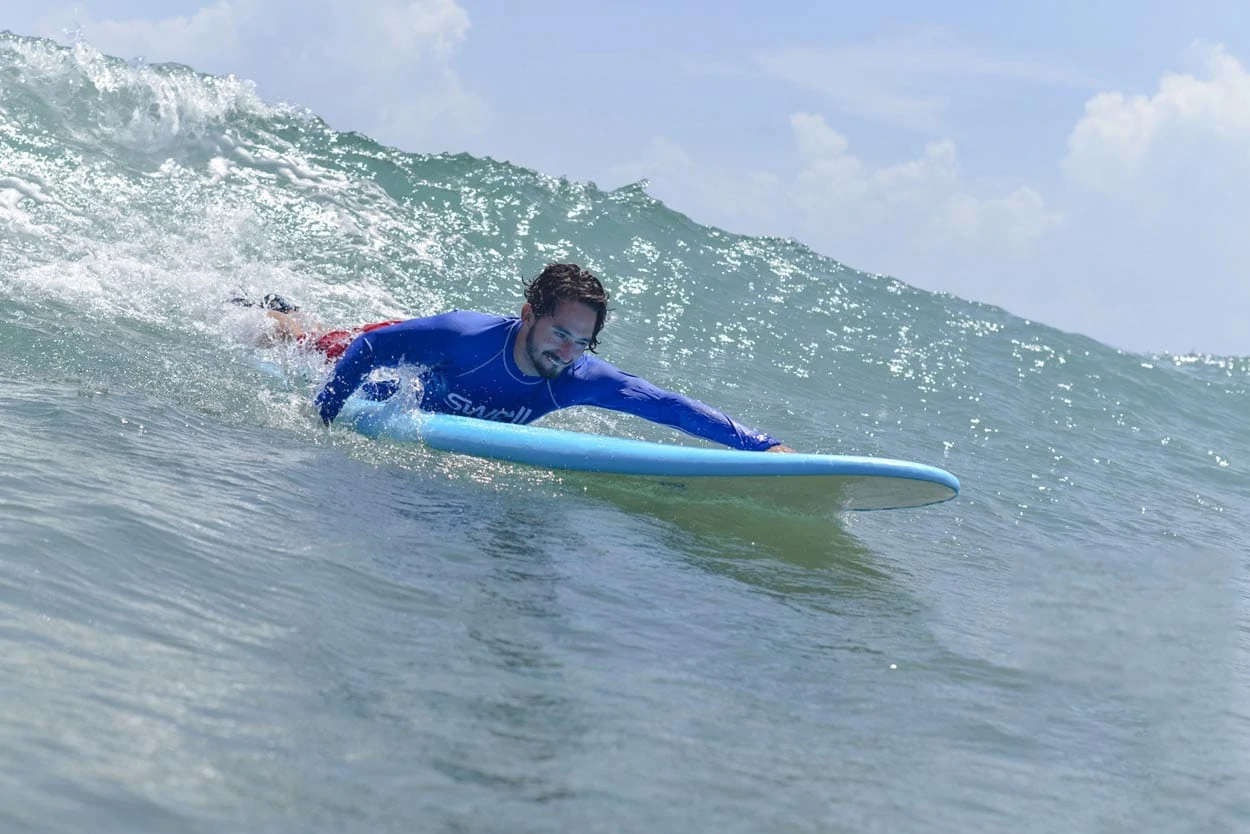
Good paddling is mostly two things: lying in the right spot so the board glides flat, and pulling water with a high elbow instead of splashing at it. Get those right and surfing stops feeling like a fight. Below is how to paddle on a surfboard properly — body position, the stroke, and the mistakes we correct most in a beginner’s first session.
Almost everyone who tries surfing for the first time says the same thing when they come in: “I had no idea it was this much work.” They’re not talking about standing up. They’re talking about paddling. Learning how to paddle on a surfboard is the part nobody pictures when they imagine surfing, and it’s the part that decides whether your first few days are joyful or just exhausting.
Here’s the good news. Paddling that burns you out is almost always a technique problem, not a fitness problem. When people struggle, it’s rarely because they’re weak — it’s because they’re lying in the wrong place on the board and dragging water they don’t need to. Fix the position, tidy up the stroke, and the same body suddenly travels twice as far for the same effort. This is the single biggest lever a beginner has, which is why we spend real time on it from day one.
Why paddling is 90% of surfing
You’ll spend far more of every session lying down and paddling than you ever will riding a wave — most surfers reckon it’s around 90% of their time in the water. That’s why efficient paddling matters more than anything else early on: it’s what gets you out the back, into position, and moving fast enough to catch the wave in the first place.
Think of paddling as the engine and the wave as the reward. If the engine is inefficient, everything downstream suffers: you reach the line-up already tired, you’re too slow to catch the good ones, and you spend the ride you finally earn gasping. Beginners often assume the answer is to get fitter. Fitness helps — surfing uses your upper back, shoulders and core in ways daily life doesn’t — but no amount of fitness rescues bad position. Technique first, conditioning second.
The physics, in plain English: drag versus propulsion
Every paddle stroke is a tug-of-war between two forces. Drag is everything slowing you down — mostly your own body and board pushing water aside. Propulsion is the water you push backwards to move yourself forwards. Faster paddling isn’t about pulling harder; it’s about creating less drag and catching more water with each stroke.
You don’t need the science to feel it. You’ve felt drag any time you’ve tried to walk quickly through waist-deep water. The whole of good paddling technique is just a set of small habits that lower drag (lie flat, stay still, keep your legs up) and raise propulsion (reach long, drop the forearm, pull water straight back). Keep those two words in your head — less drag, more push — and everything below is just detail.
Find your sweet spot: where to lie on the board
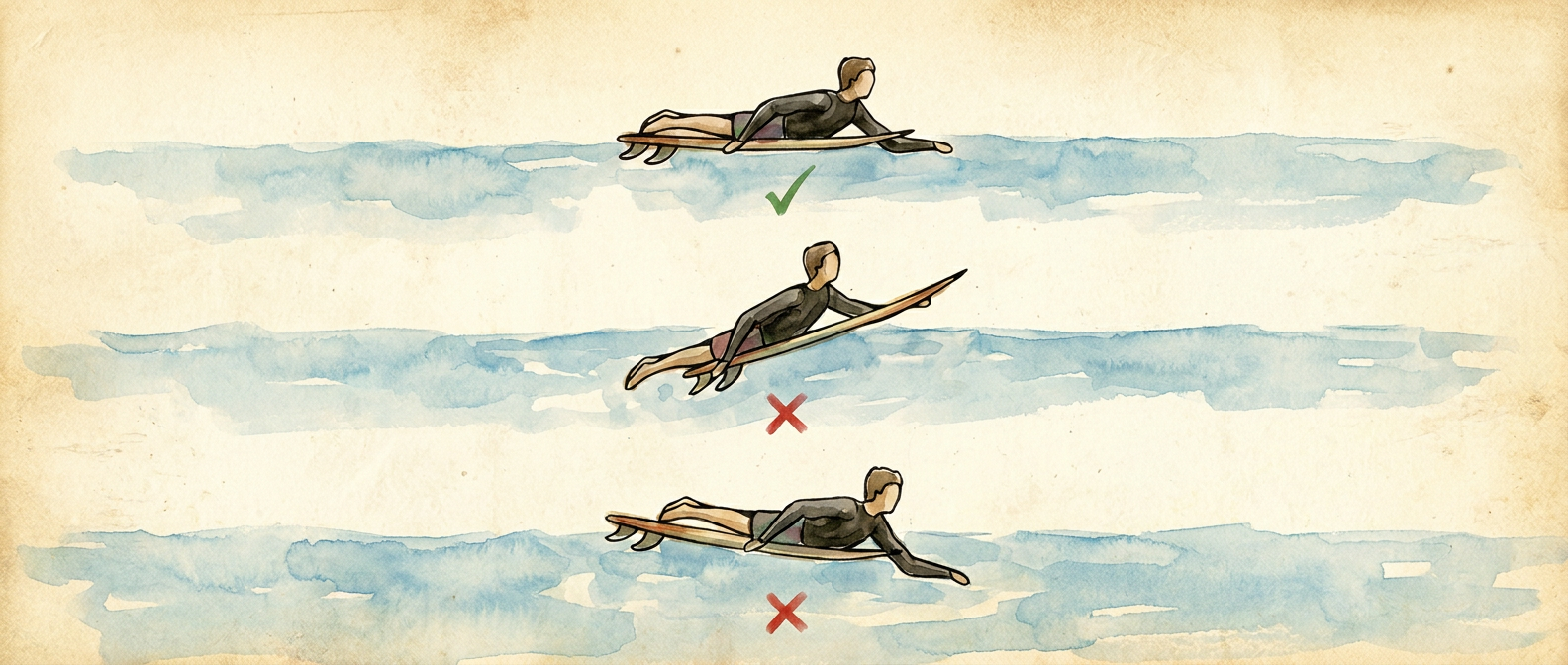
The “sweet spot” is the exact place along the board where it sits flattest in the water. Lie there and the nose hovers an inch or two above the surface while the tail stays level. Too far forward and the nose knifes under; too far back and the tail sinks while the nose points at the sky. Both bury the board and murder your speed.
Every board has a slightly different sweet spot, and it shifts with your weight and the board’s volume. A high-floating foamie or longboard will have you a touch further back than a thin board. The fastest way to find it: paddle a few strokes in calm water and watch the nose. Chasing the nose up and down until it settles an inch or two clear of the surface is the whole game. Once you’ve found it, remember it — line your chest up with the logo or a wax mark so you can drop straight onto the spot every time.
Stay centred and streamlined
Position isn’t only front-to-back — it’s side-to-side and top-to-bottom too. Three habits keep you streamlined, and none of them cost energy.
Line up along the centre. Your spine should run straight down the middle of the board, like lying along a very wide balance beam. If you list to one rail, that edge digs in and drags. A quick test: lift both hands off the water at once. If you tip to one side, you’re not centred — adjust until you can lie still and balanced.
Chest up, head up, eyes forward. Arch your back gently so your weight rests on your lower ribs, lift your chest, and look at the horizon rather than the nose. Beginners often flatten out and rest their forehead on the board when they tire — which drops the nose, drags the board and blinds you to incoming waves. A useful cue: imagine holding a tennis ball under your chin.
Feet together, legs up. Let your legs dangle and they act like a sea anchor off the tail. Keep your feet together and lifted just clear of the surface. It feels like a small thing and makes a surprising difference to your glide.
“On day one almost everyone tells me surfing is exhausting. By day three, once their position clicks, the same people are paddling into waves themselves and grinning. Nothing about their fitness changed in 48 hours — their technique did.”
— Clare Mutsaars, co-founder & host at Swell since 2009
The stroke, in four phases
A single paddle stroke has four parts: the entry (hand slips in ahead of your head), the catch (you set a high elbow and drop the forearm), the pull (you draw water straight back beneath you), and the recovery (elbow lifts out and swings forward). Paddle one arm at a time in a smooth, unhurried rhythm — never both together.
Two rules tie the four phases together. First, reach long. Short, frantic strokes exhaust you and barely move the board; long, smooth strokes glide. There’s an old swimming line that fits perfectly here: slow is smooth, and smooth is fast. Second, quiet hands. Splashing is wasted energy and a sign your hand entered flat instead of fingertips-first. The quieter your paddle, the cleaner your technique.
High elbow: the one habit that changes everything
If you only fix one thing, fix this. A high elbow during the catch and pull is what lets your hand and forearm work together as a single, large paddle blade. Drop the elbow — lead the stroke with it, arm straight — and you end up pushing water down and up rather than back, which does almost nothing to move you forward.
The mental image most people find useful: as your hand enters and sinks, pretend you’re reaching your arm up and over a floating log, keeping the elbow near the surface while the forearm hangs straight down. Hold that shape and pull. You’ll feel the water load up against your forearm — that pressure is propulsion you were previously throwing away.
The entry sets this up. Slide your hand in ahead of your head, close to the rail, with the fingertips entering first — wrist higher than fingers, elbow higher than wrist. That angle plants you straight into a high-elbow catch. Enter flat or wide and you’ve lost the position before the stroke even starts.
Keep your strokes close to the rail
Paddle close to the edges of the board, not out wide. Wide, sweeping strokes look powerful but push you side to side instead of forward, lean too hard on your shoulders, and keep your forearm too shallow to grip much water. Track your hands just alongside the rails and pull straight back.
Sprinting and kicking: when (rarely) to use them
As a wave arrives you’ll sometimes need one last burst to match its speed and drop in. That’s when you sprint: same technique, just a higher stroke rate for a few strokes. Don’t change your form — just turn up the frequency as the wave lifts you.
Kicking is more limited. A few short, fast kicks from the hips (not big scissoring knees) can add a touch of drive and lift your weight forward at the critical moment, but only on a board small enough that your feet float behind the tail — and it burns a lot of energy for little return. For most beginners on high-volume boards, the honest advice is simple: keep your legs still and let your arms do the work. Save kicking for the rare moment you truly need it.
Your board is doing half the work
Perfect technique on the wrong board still feels like hard work. Volume — how much float a board has — is the biggest factor in how easily it paddles. More volume means the board sits higher, drags less and catches waves sooner, which is exactly why beginners learn faster on bigger, thicker boards.
If you’re doing everything right and still crawling, you’re probably underboarded. There’s no glory in struggling on a board that’s too small — even strong surfers size up on tired days. On a learn-to-surf week with us, this is handled for you: we match foamies, funboards and longboards to your level and the day’s waves, so the equipment is quietly working in your favour instead of against you.
Practise it before you hit the line-up
Paddling is trainable on dry land and in flat water, and it’s the cheapest progress you’ll ever make. You can rehearse position and the stroke shape lying on a towel, then feel it for real in calm, waist-deep water — no waves required. Every minute here saves you two in the ocean.
It’s why we start paddle work before anyone’s chasing a wave. Grooving position and the high-elbow stroke somewhere calm means that when you do paddle for a real wave, your body already knows the shape — you can spend your attention on the ocean instead of your arms. Between sessions, our afternoon yoga keeps the shoulders, back and hips loose, which is exactly the mobility good paddling asks for.
Common mistakes we fix in the first session
If you recognise yourself in this list, you’re in good company — these are the usual suspects, and every one is an easy win.
- ✕Splashing on entry. Flat, slappy hands mean drag and lost power. Slip the fingertips in first, quietly.
- ✕Cupping the hand. A tense, cupped hand catches less water than a relaxed, straight one. Keep the fingers together and easy, with a small gap.
- ✕Dropping the elbow. Leading with a low elbow pushes water down, not back. Keep it high through the catch and pull.
- ✕Paddling both arms together. You lose momentum every time both hands leave the water. Alternate, one arm always pulling.
- ✕Head down, resting on the board. It sinks the nose and hides the waves. Chin up, eyes forward.
- ✕Legs down and apart. A built-in brake. Feet together, lifted, still.
- ✕Wide strokes. Rocking side to side wastes energy. Track the rails.
The takeaway
Learning how to paddle on a surfboard well comes down to a handful of habits: lie on your sweet spot so the board glides flat, stay centred with your chest up and legs together, and pull water with a high elbow in long, quiet strokes. None of it is about brute strength. It’s about not fighting the water — and once it clicks, surfing feels like a completely different sport.
That click happens fastest with someone watching your position and correcting one thing at a time. If you’d like to skip months of trial and error, that’s exactly what a week with us is for. Have a look at our surf retreat, or tell us your dates for a quote — small groups, patient coaching, and the right board under you from the very first paddle. You can also see where you’ll stay between sessions.
How to paddle on a surfboard: FAQ
Why is paddling so tiring for beginners?
Because it’s usually a technique problem, not a fitness one. Lying too far forward or back, dropping your legs, and pushing water sideways all add drag your muscles then have to overcome. Fix your position and stroke and the same effort carries you much further. Paddling also uses upper-back and shoulder muscles most people rarely train, so some early fatigue is normal and fades quickly.
Where exactly should I lie on the board?
On your “sweet spot” — the place where the board sits flattest, with the nose an inch or two above the water and the tail level. It varies by board and body weight, so find it by paddling in calm water and watching the nose: shuffle forward if the tail sinks, back if the nose knifes under. Mark the spot so you can drop onto it every time.
Should I paddle with one arm or both at once?
One arm at a time, in a steady rhythm, with one hand always pulling. Paddling both arms together (a “butterfly” stroke) is rarely needed and actually loses speed, because you stall every time both hands leave the water. Save any two-arm effort for the final push into a wave.
Does the surfboard I use really make a difference?
A big one. A board’s volume — its float — is the biggest factor in how easily it paddles. More volume sits higher, drags less and catches waves sooner, which is why beginners progress faster on larger, thicker boards. If good technique still feels like hard work, you’re likely on a board that’s too small.
Can I practise paddling without waves?
Yes, and you should. You can rehearse your body position and the stroke shape on dry land, then feel it for real in flat, waist-deep water. It’s the cheapest way to improve and it means your body already knows the movement when a real wave comes. We build this into the first day of every surf week for exactly that reason.
Clare Mutsaars
Clare co-founded Swell in 2009 and has spent more than fifteen years hosting and coaching beginner and improver surfers in Cabarete, Dominican Republic. She writes the Swell journal on learning to surf and wingfoil as an adult.
Clare Mutsaars is the co-founder of Swell Active, the adult surf and wingfoil retreat she and Jeroen Mutsaars built from scratch in 2009 on the north coast of the Dominican Republic. They opened it after travelling the world in search of the ideal place for busy grown-ups, with no board-sports background, to learn a watersport safely and quickly. Fifteen years on, Clare still runs the guest side of the retreat and answers enquiries herself, usually within a day. Her expertise is experience, not theory: she has spent more than a decade watching first-time adults go from nervous on the beach to flying on a foil or riding their first green wave, which means she knows the real questions people have before they book.
More from Clare Mutsaars →