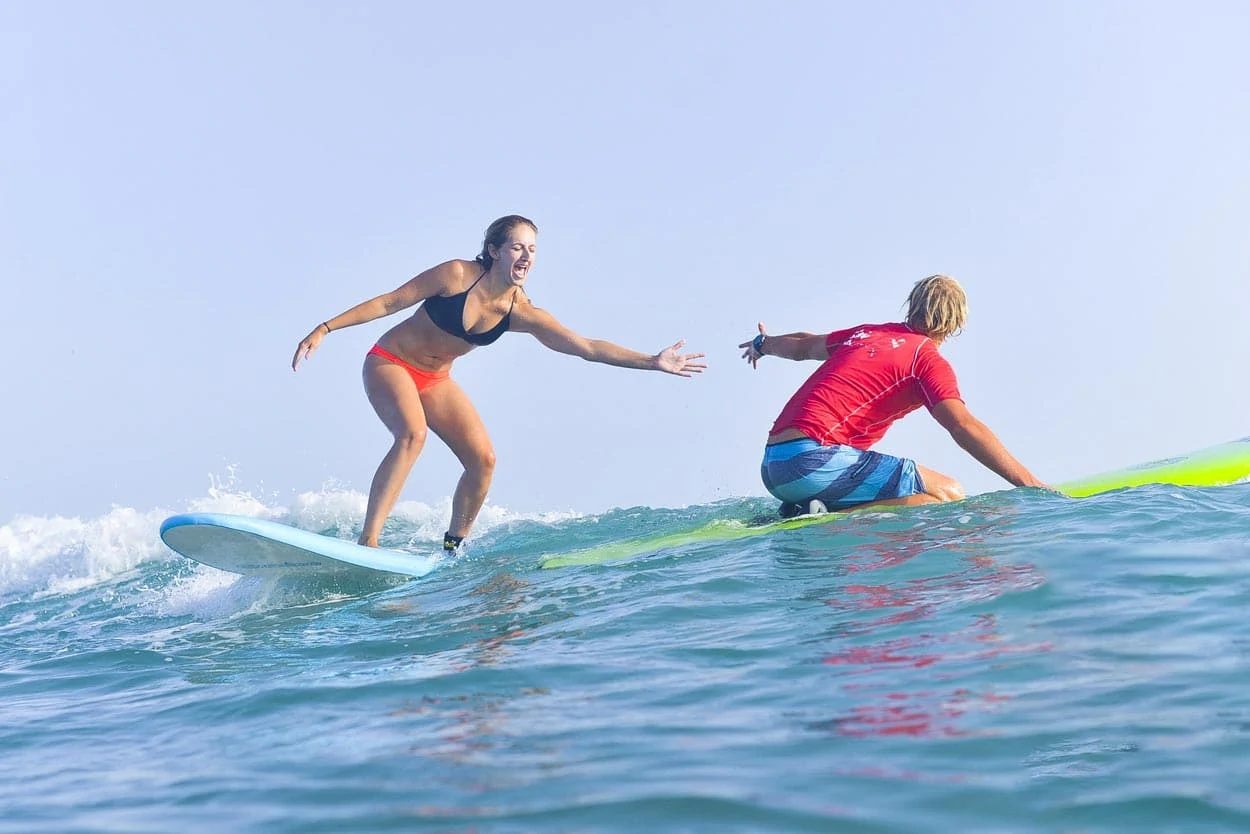
It depends what you mean by “learn.” In a week you can realistically stand up, ride broken waves, and catch your first unbroken (green) waves. Coaches reckon it takes roughly 5 to 20 hours in the water to ride a wave, and 20 to 30 to feel like a comfortable beginner. A structured week of daily coaching delivers exactly that. What a week won’t do is make you a fully independent surfer. That takes months.
“Can you learn to surf in a week?” is the question we’re asked more than any other. The honest answer is yes, and no, and it hinges entirely on one word: learn. Surfing isn’t a single skill you either have or don’t. It’s a ladder, and a good week gets most beginners several rungs up it.
So let’s answer it properly. Not with hype, and not with the usual “anyone can do it!” hand-waving, but with the actual milestones, the hours behind them, and what our coaches have watched happen with thousands of adult beginners since 2009. By the end you’ll know exactly what a week can and can’t give you, and how to make your seven days count.
First, what does “learning to surf” actually mean?
Learning to surf isn’t one skill, it’s four stages: standing in whitewater, riding green (unbroken) waves, surfing independently, then refining style. A week takes most beginners cleanly through the first two and gives them a taste of the third. The later stages take months to years, and that’s true for everyone.
Almost every argument about how fast you can learn comes down to people meaning different things by the same word. Standing up on a foamy in the whitewash and reading a crowded reef break are both “surfing,” but they’re years apart. Here’s the ladder we coach against.
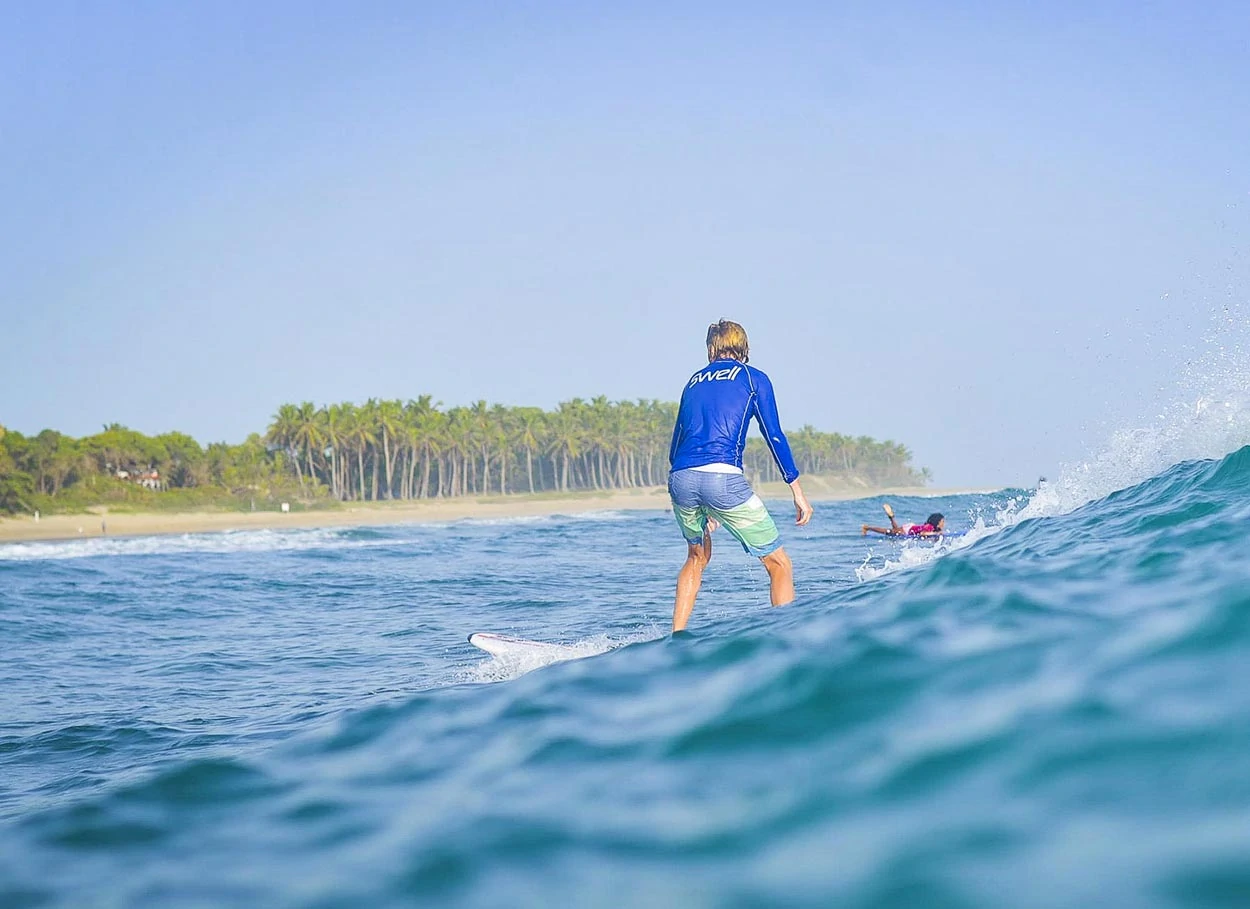
| Stage | What you can do | Typical time to get there |
|---|---|---|
| 1. Whitewater | Pop up and ride the broken foam straight to shore on a big soft board | First 1–2 sessions |
| 2. Green waves | Catch and ride unbroken waves, angle along the face, ride for several seconds | Roughly 8–16 coached sessions |
| 3. Independent | Paddle out, read waves, pick your spot, handle a small lineup on your own | Several months of regular surfing |
| 4. Refining | Turns, trimming, style, bigger and more varied conditions | A year and beyond — ongoing |
Stages generalised from how surf schools and coaches describe beginner progression. Your mileage varies with fitness, conditions, and time in the water.
When a beginner asks “can I learn in a week,” they almost always picture Stage 2: catching a real wave and riding it, grinning, under their own steam. That is a genuinely realistic goal for seven days. Becoming the person paddling out alone at a busy break, Stage 3, is not. Keeping those apart is the whole trick to answering the question honestly.
So, can you learn to surf in a week?
Yes, for the parts most people actually care about. In a week of daily coaching, the large majority of beginners stand up on day one, ride whitewater confidently by mid-week, and catch their first green waves before they fly home. You won’t leave a “finished” surfer, because no one ever is, but you’ll leave genuinely surfing.
The evidence is remarkably consistent. Surf schools widely report that a never-surfed beginner learns the basics, paddling, popping up, riding straight, in just one or two lessons. Experienced coaches writing for Surfertoday estimate that, on a big, wide, forgiving board, most people can expect to ride a wave after somewhere between five and twenty hours of practice. That’s not months. That’s a week.
It matches what we see on the beach. Warm, waist-deep water and mellow, rolling waves do a lot of the teaching for us. Most of our guests have never surfed before, and most are standing and riding foam on the first morning. By the last day, a big share are catching unbroken waves and riding them properly. The week doesn’t make them experts. It makes them surfers who now have something real to build on.
Why a week beats a year of weekends
Frequency is the single biggest factor in how fast you learn, ahead of talent, age, or gear. Surfing every day for a week builds momentum that scattered weekend sessions never do, because muscle memory fades between sessions. Seven consecutive days can bank more real progress than six months of the occasional Saturday.
Here’s the part almost nobody explains. Progress in surfing isn’t linear, it compounds, and it leaks. Each session you build feel and paddle fitness; each long gap, you lose a little of it. Surf once a month and you spend half of every session re-learning what you’d already cracked. Surf seven days straight and each morning starts where the last one finished. The learning stacks.
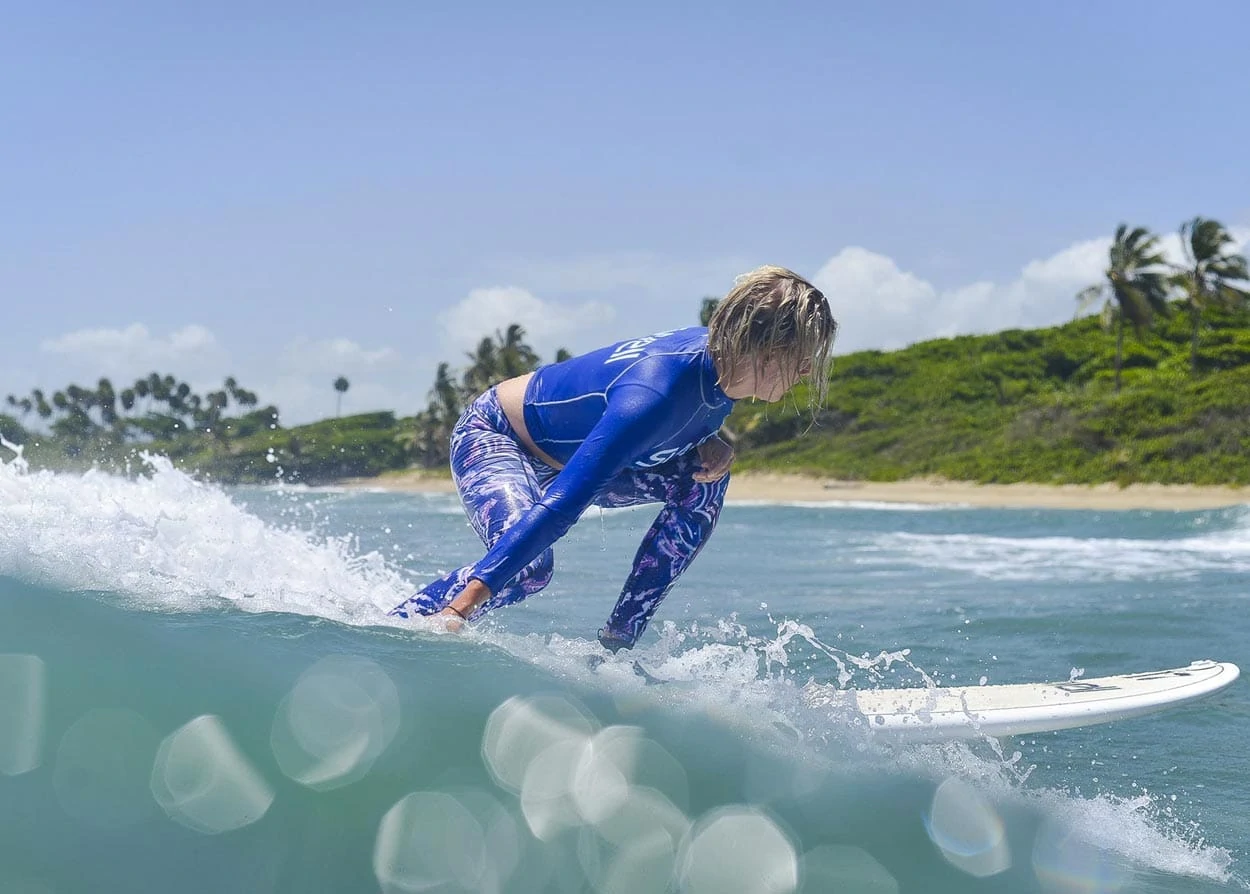
Put the hours side by side and it’s stark. Most coaches put “comfortable beginner” at around 20 to 30 hours in the water. Look at how long that takes at different rhythms.
Illustrative, based on ~25 hours to reach a confident-beginner level. Bar length shows how quickly each rhythm banks those hours, not total skill.
And this assumes the weekend surfer even has good waves on the days they show up, which they often don’t. A dedicated week removes the two things that stall home learners most: the gaps between sessions, and the luck of the forecast. You surf every day, in conditions chosen for your level. That’s why an intensive week can compress months of stop-start progress into one clean run.
What speeds you up, and what slows you down
If frequency is the biggest lever, it isn’t the only one. Five things decide how far up the ladder you get in seven days. The good news for most of our guests: almost all of them are things a good retreat controls for you.
| Factor | Speeds you up | Slows you down |
|---|---|---|
| Frequency | Daily sessions, back to back | One session, then a week off |
| Waves | Small, warm, rolling beginner waves | Cold, dumpy, or crowded surf |
| Board | Big, wide, stable soft-top | A short board picked for looks |
| Coaching | Small groups, feedback each session | Self-taught, guessing at mistakes |
| Body & comfort | Reasonable fitness, happy in the ocean | Low fitness, nervous in the water |
Notice what’s not on that list as a make-or-break: natural talent. It helps at the margins, but it’s swamped by the five factors above. A nervous beginner in the right water with the right board and a coach beside them will out-progress a “natural” freezing on a too-small board at a heavy beach with nobody watching. Every time.
The board point is worth dwelling on. Beginners routinely sabotage themselves with equipment that’s too small because it looks the part. A large, stable board catches waves earlier and forgives clumsy pop-ups, which means more waves ridden, which means faster learning. It’s the least glamorous and most important choice you’ll make. On our learn-to-surf retreat, the board is matched to you and the day, so that decision is simply taken care of.
A realistic week, day by day
A typical learn-to-surf week runs two sessions a day, building from beach drills to green waves. Day one is standing in the foam; by mid-week you’re riding whitewater confidently; by the end you’re catching unbroken waves. Rest and recovery are built in, because tired beginners stop improving.
No two weeks are identical, because the ocean gets a vote. But a well-run week has a clear arc, and it looks something like this.
- Land drills and first foamPop-up technique, stance and safety on the sand, then straight into the whitewater. Most people stand and ride broken waves in the very first session. Expect to fall a lot. That’s the job.
- Confidence in the whitewaterMore reps, cleaner pop-ups, longer rides in the foam. Your paddling starts to feel less like flailing. The nerves settle and it starts to be fun rather than frantic.
- Reading the waterYou begin learning where waves break and how to position, plus how to paddle for a wave rather than wait for it. Coaches fix one thing at a time so nothing overwhelms you.
- First green wavesThe big one. You paddle for unbroken waves and ride a clean, open face for the first time. It’s a different feeling entirely, and it’s usually the moment people get hooked for life.
- Linking it togetherMore green waves, angling along the face, staying on your feet longer. Consistency builds. You start to look like a surfer, not someone fighting the sea.
- Putting it to useA session to consolidate everything, ride your best waves of the week, and understand what to practise next. You leave knowing where you are on the ladder and how to keep climbing.
Two sessions a day is deliberate. It’s enough repetition to keep the momentum stacking, with recovery between so your body absorbs each step instead of just getting exhausted. That balance of effort and rest is why a good week feels restorative rather than like a boot camp. It’s also why we build gentle recovery into the week, including yoga aimed at the shoulders, hips and spine that surfing works hardest, which you can read more about in our guide to the surf and yoga retreat.
Clare Mutsaars, Swell Active co-founder
Am I too old to learn in a week?
Almost certainly not. Age is one of the most overrated factors in learning to surf. Coaches widely agree that a fit, calm 60-year-old will out-learn an unfit, anxious teenager. Fitness, comfort in the water, and attitude matter far more than the year on your passport, and adults often progress faster because they listen.
Our average guest is in their forties, and it’s a mixed, co-ed group of working professionals, not a young crowd. That’s not a limitation, it’s a pattern we see pay off. Adults take instruction seriously, ask good questions, and don’t burn the week trying to show off. Surf programmes echo this: many report that motivated adults move past the beginner stage in as few as four to a dozen coached sessions, with fitness, not youth, the thing that actually sets the pace.
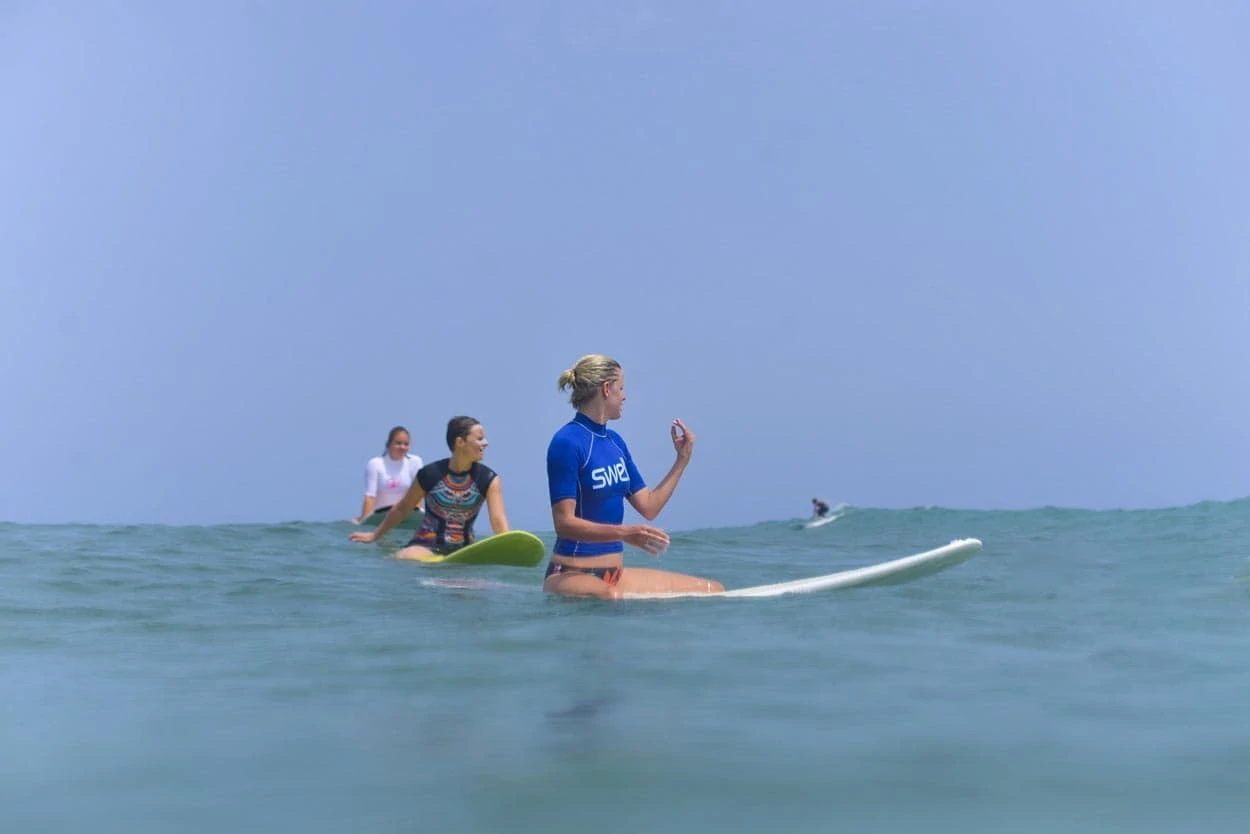
What helps most at any age is turning up reasonably fit and comfortable in the water. If you can swim confidently and you’ve done a little to prepare your paddling muscles, you’ll spend your week learning to surf rather than learning to cope. Age won’t be the thing that holds you back.
What a week will not do (the honest bit)
A good week is genuinely transformative. It is not magic, and anyone promising you’ll leave a “complete surfer” is selling something. Here’s the honest split of what seven days does and doesn’t deliver.
What a week gives you
- Standing and riding whitewater with confidence
- Your first proper green-wave rides
- The basics of paddling, positioning and pop-ups
- Around 20–30 hours in the water, the confident-beginner threshold
- A real foundation to build on at home
What it won’t (yet)
- Independence in a crowded or powerful lineup
- Reliable wave reading in varied conditions
- Turns, carving and style
- Bigger waves or reef breaks
- The “surfer for life” fluency that takes months to years
Being upfront about the right-hand column is the point, not a disclaimer. Surfing is a lifelong sport precisely because it never runs out of ladder. A week gets you genuinely, joyfully surfing and shows you the path forward. The rest is the fun of the years that follow.
How to make your one week actually count
To get the most from a single week, stack the odds: choose daily coaching over one-off lessons, warm and forgiving waves over challenging ones, small groups over crowds, and a big stable board over a stylish one. Then arrive able to swim, reasonably fit, and ready to fall over a lot.
If you only have one week to give surfing, the difference between a frustrating trip and a life-changing one is almost entirely in the setup. A few things to look for:
Pick consecutive days, not scattered lessons
Momentum is everything. Seven days in a row beats fourteen spread over two months. A dedicated retreat structures the whole week around that momentum, which is the entire reason it works.
Choose the water carefully
Warm, gentle, beginner-friendly waves are worth more than famous ones. You want a spot that forgives mistakes, so you can make thousands of them cheaply. That’s exactly why the north coast of the Dominican Republic suits first-timers so well, and it’s the ground our whole surf retreat is built on.
Sort the rest so you can just surf
Coaching, the right board, transport to the best beginner break each day, a comfortable bed and proper food, all of it exists so your energy goes into the water and nowhere else. When the logistics disappear, the learning speeds up. You can see how we handle the whole week on the retreat page.
Thinking about your one week?
We’ve taught adults to surf on the same warm, forgiving coast since 2009, most of them complete beginners, most travelling solo. Tell us your dates and we’ll send a personal price and availability quote, usually the same day.
The honest answer, in three lines
Can you learn to surf in a week? If “learn” means stand up, ride waves, and leave genuinely surfing, then yes, and it’s the single fastest way to do it. If it means becoming a fully independent surfer, no, and nothing gets you there in seven days. What a good week really does is compress months of stop-start progress into one clean, warm, well-coached run, and hand you a foundation you’ll build on for years.
Frequently asked questions
Can a complete beginner really learn to surf in a week?
Yes. Most people who have never surfed can stand up and ride broken waves in their first session or two, and catch their first unbroken green waves within a week of daily coaching. You won’t leave a finished surfer, but you’ll leave genuinely surfing, with a real foundation to build on.
How many hours does it take to learn to surf?
Surf coaches commonly estimate around 5 to 20 hours in the water to ride a wave on a suitable board, and roughly 20 to 30 hours to feel like a comfortable beginner. A structured week of two sessions a day comfortably delivers that, which is why an intensive week banks more progress than months of occasional weekend surfing.
Is a week enough, or should I book longer?
A week is enough to get genuinely surfing and to know whether you’re hooked. Most beginners reach their first green waves inside seven days. If you already know you love it, or you want to move toward surfing independently, a second week roughly doubles your water time and noticeably deepens the progress.
Am I too old to learn to surf in a week?
Almost certainly not. Fitness, comfort in the water and attitude matter far more than age, and a fit, calm adult routinely out-learns an anxious teenager. Our average guest is in their forties, and adults often progress faster because they take coaching seriously and pace themselves sensibly.
What’s the fastest way to learn to surf?
Daily coaching, in warm and forgiving beginner waves, on a big stable board, in small groups. Remove the gaps between sessions and the luck of the forecast, and you learn far faster than a self-taught surfer catching the occasional weekend. That combination is exactly what a dedicated surf retreat is designed to provide.
Clare Mutsaars is the co-founder of Swell Active, the adult surf and wingfoil retreat she and Jeroen Mutsaars built from scratch in 2009 on the north coast of the Dominican Republic. They opened it after travelling the world in search of the ideal place for busy grown-ups, with no board-sports background, to learn a watersport safely and quickly. Fifteen years on, Clare still runs the guest side of the retreat and answers enquiries herself, usually within a day. Her expertise is experience, not theory: she has spent more than a decade watching first-time adults go from nervous on the beach to flying on a foil or riding their first green wave, which means she knows the real questions people have before they book.
More from Clare Mutsaars →